


From revolutionary legacy to green future: Beyond the Long March
On Oct. 19, 1935, the Central Red Army arrived in Wuqi county, Yan'an, northwest China's Shaanxi province, bringing the Long March to a victorious end. The county became not only the final destination of the epic journey but also the starting point for a new stage of the Chinese revolution.
Ninety years later, visitors retracing the Long March have found that Wuqi is known not only for its revolutionary legacy, but also for its remarkable ecological transformation.
As part of China International Communications Group's (CICG) international communication project, "Together on the Long March: 90th Anniversary of an Epic Journey," a group of Chinese and international experts, scholars and social media influencers visited the Wuqi Grain-for-Green Exhibition Hall to learn how the historic revolutionary site has embraced green development while improving local livelihoods.
According to Liu Aiyuan, a guide at the exhibition hall, the county of Wuqi, located on the Loess Plateau and covering 3,791.5 square kilometers, was once affected by soil erosion across 97.6% of its territory.
"At that time, sheep grazed across the hillsides and people relied on farming steep slopes for a living, which further worsened the soil erosion," Liu said.
In 1998, Wuqi responded to a national initiative to restore the ecological environment in northwest China by converting farmland back into forests and grasslands, promoting enclosed livestock breeding and developing eco-friendly agriculture.
The transition, however, was far from smooth. "Many local residents initially feared that returning farmland to forests would leave them with too little land to grow food, while grazing restrictions would reduce their income," Liu recalled." Local officials patiently explained the long-term ecological and economic benefits of the program before eventually winning public support."
Inspired by the spirit of the Long March, officials and residents planted trees and launched what was described as a"green revolution." The campaign has fundamentally changed Wuqi's landscape.
According to Liu, by 2024, the county's forest coverage had risen from 6.5% to 20.3%, while vegetation coverage increased from 19.2% to 72.9%. The average annual number of sandstorms dropped from 19 to five, and the number of wild bird species increased from about 50 to 197.
The environmental improvements have also reshaped the local economy.
Although cultivated land has decreased, grain output has continued to increase thanks to improved agricultural efficiency. In recent years, local authorities have invested nearly 200 million yuan annually to support three pillar industries— apples, animal husbandry and greenhouse agriculture. Many residents have also found new opportunities in eco-tourism.
In 2024, the per capita disposable income of rural residents reached 18,119 yuan, more than 20 times that in 1997, Liu said.
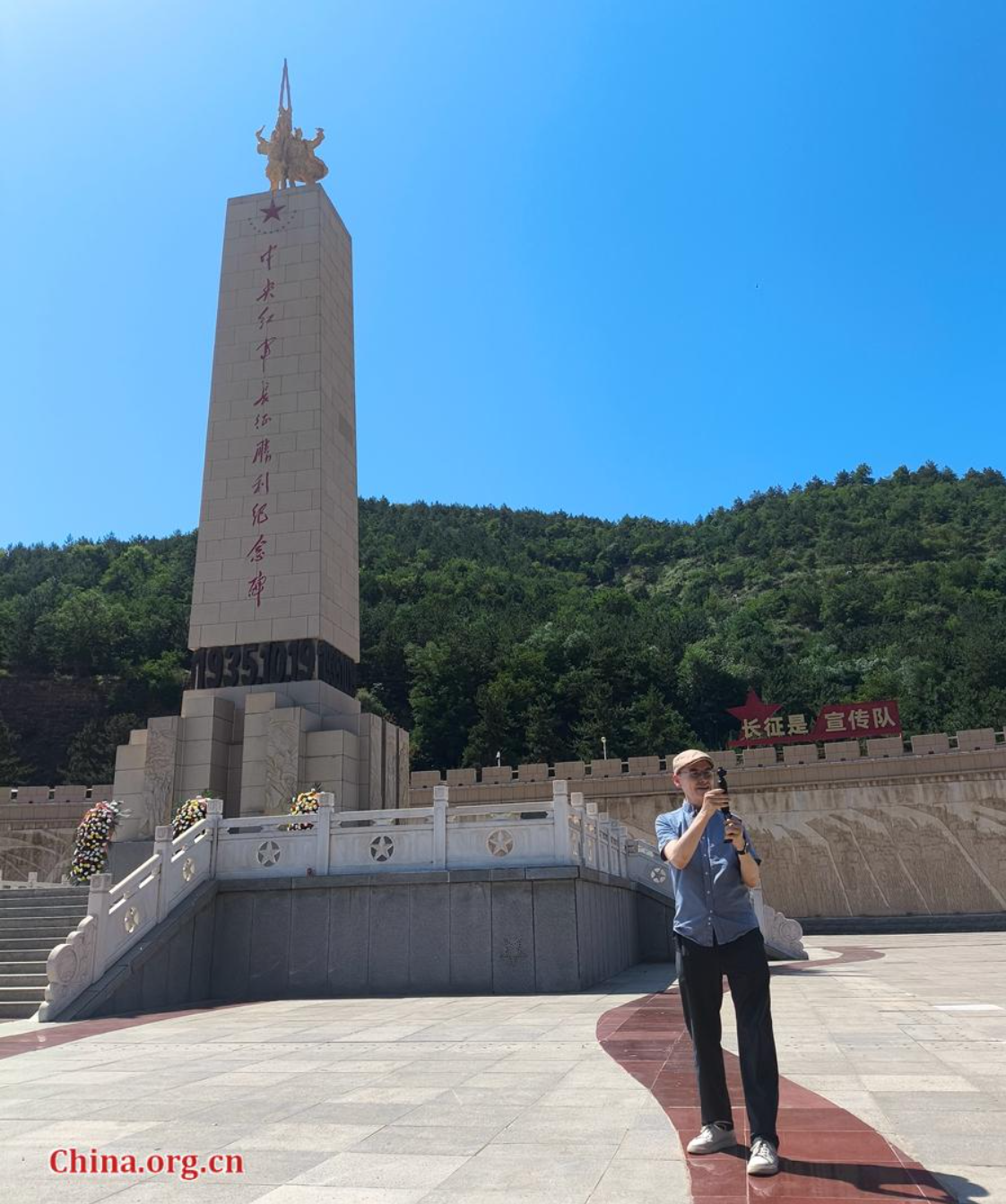
Zachary G. Lundquist, a foreign editor and reporter at the Center for Europe and Africa of CICG, takes a selfie in front of the Monument Commemorating the Victory of the Central Red Army's Long March in Wuqi county, Yan'an, Shaanxi province, July 23, 2026. [Photo by Xu Xiaoxuan/China.org.cn]
For Zachary G. Lundquist, a foreign editor and reporter at the Center for Europe and Africa of CICG, Wuqi's transformation reflects a common thread linking its revolutionary past with its green future.
"Wuqi is a revolutionary site, and today it is pursuing green development. Whether it's'red' or'green,' both are about improving people's well-being and promoting development," he said.
Lundquist believes the county's greatest achievement goes beyond restoring forests.
"Changing the environment is difficult, but changing people's mindset is even harder," he said. "Getting local communities to voluntarily protect the environment and take part in these efforts is a valuable experience."
He added that China's commitment to accelerating its green transition, outlined in the country's 15th Five-Year Plan (2026-2030), combines clear goals with concrete actions, offering useful lessons for other countries.
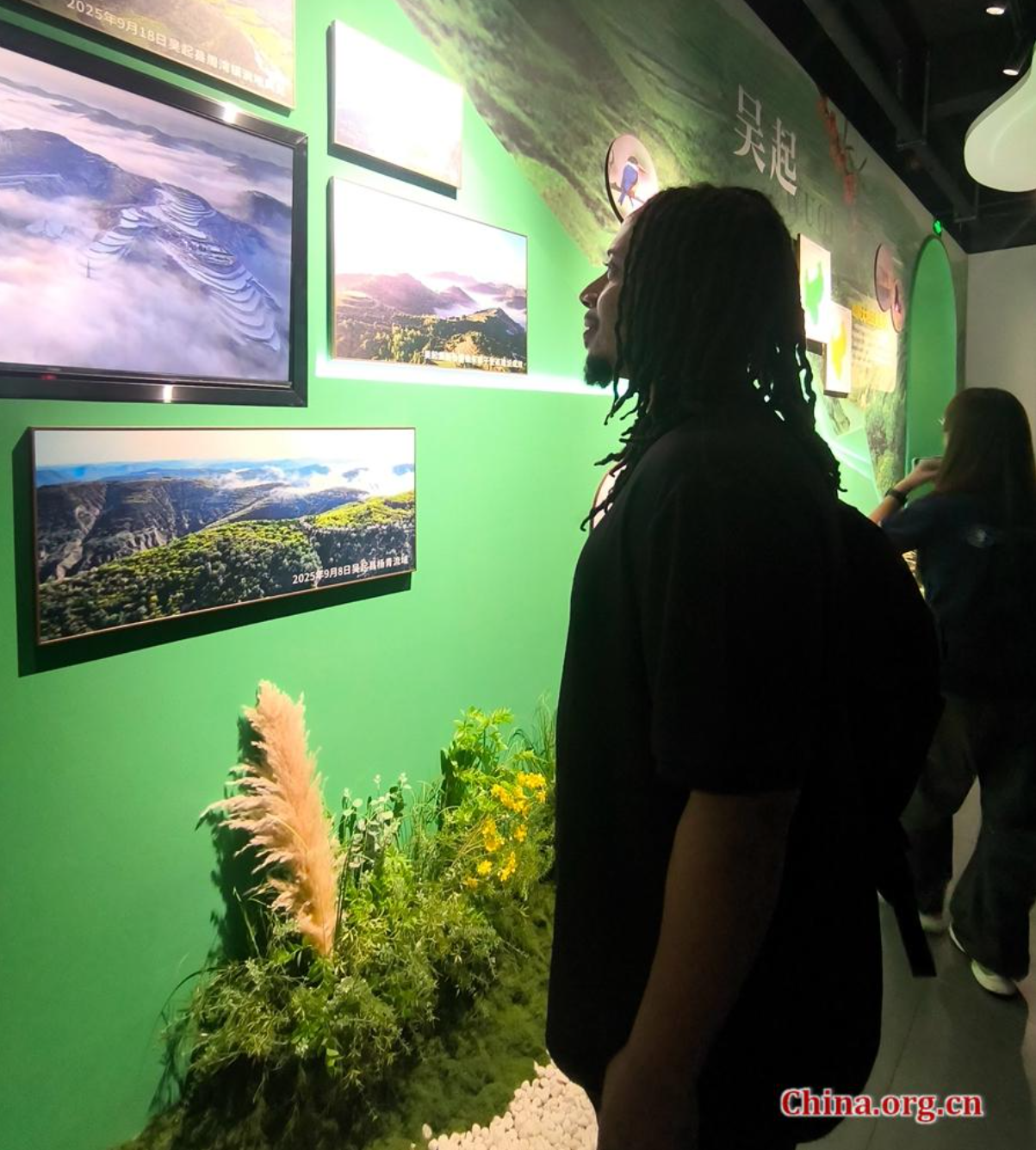
Zhavier Harris, marketing and communications manager of the Springfield Urban League in the United States, views exhibits showing Wuqi's grain-for-green achievements at the exhibition hall in Wuqi county, Yan'an, Shaanxi province, July 23, 2026. [Photo by Xu Xiaoxuan/China.org.cn]
Zhavier Harris, marketing and communications manager of the Springfield Urban League in the United States, also saw a strong connection between Wuqi's revolutionary history and its ecological transformation.
"There would be no green culture without red culture," he said.
"We've seen areas that were once barren become green. China is honoring the sacrifices of the Long March by continuing to develop the region and make life better for its people."
Speaking about China's ecological restoration efforts, Harris said investing in sustainable communities means investing not only in the present, but also in future generations.