


Dhaka hosts China-Bangladesh roundtable on governance
The second China-Bangladesh Roundtable on Governance Experience Exchange was held in the Bangladeshi capital Dhaka on Sept. 21, bringing together more than 100 experts, scholars, and government officials from China and Bangladesh.
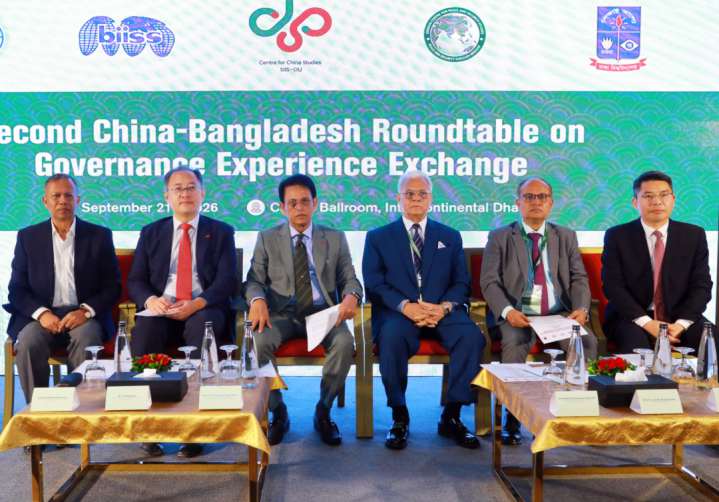
The second China-Bangladesh Roundtable on Governance Experience Exchange is held in the Bangladeshi capital Dhaka, Sept. 21, 2026. [Photo/CICG]
A. B. M. Obaidul Islam, vice chancellor of the University of Dhaka, said in his keynote address at the opening session that China is an important and trusted development partner of Bangladesh. Over the years, their partnership has achieved fruitful outcomes in areas including infrastructure, trade, and investment. He said education and scientific research should become an increasingly important component of bilateral ties.
The vice chancellor noted that the University of Dhaka, as an important hub for China studies in Bangladesh, will continue to promote substantive academic exchanges between the two countries through the Center for China Studies (CCS), work to connect research findings with development needs, and further strengthen the institutional foundations for cooperation between Bangladesh and China.
Li Kaisheng, vice president of the Shanghai Institutes for International Studies, said in his keynote address that the world is facing multiple challenges, including unilateral hegemony, regional conflicts, climate change, and rapid advances in artificial intelligence, which call for countries to work together to find solutions.
Li said countries of the Global South need not only to safeguard their right to development, but also to value the role of governance, as good governance is critical to modernization. He described the roundtable as a platform for two-way exchange, noting that Bangladesh could draw on China's experience in development and people-centered approaches, while China also looks forward to learning from Bangladesh's perspectives on regional transformation, the blue economy, and disaster mitigation.
Li Shaopeng, cultural counselor of the Chinese Embassy in Bangladesh, delivered a keynote speech on behalf of Ambassador Yao Wen at the opening session. He said that China and Bangladesh should learn from each other based on their respective national conditions and work together to address the current challenges. In recent years, mechanisms for exchanging governance experience between the two countries have continued to improve and expand, with the CCS becoming an important platform for dialogue between think tanks in the two countries. These achievements, he said, are a vivid reflection of knowledge sharing and greater mutual understanding between the Chinese and Bangladeshi peoples.
Looking ahead, the cultural counselor said China is ready to work with Bangladesh to make exchanges of governance experience an important pillar of efforts to build a China-Bangladesh community with a shared future in the new era.
Bangladesh's education minister, A. N. M. Ehsanul Hoque Milon, said in his keynote speech that China and Bangladesh enjoy a longstanding friendship and a strong foundation of mutual trust, while bilateral cooperation is entering a new phase of development with fresh opportunities for further deepening ties. He said infrastructure creates the conditions for development, but Bangladesh must also turn its large young population into a highly skilled human resource base. As two populous countries, China and Bangladesh can learn from each other's experiences in areas such as job creation, industrial upgrading, and balanced urban-rural development.
He expressed hope that universities in the two countries will further expand cooperation in vocational education, joint research, and faculty and student exchanges, so that the outcomes of such discussions can extend beyond the conference room and bring tangible benefits to people in both countries.
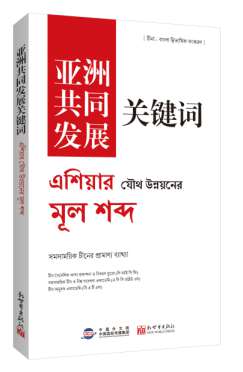
The Bengali-language edition of "Keywords to Understand China: Common Development in Asia" is released during the second China-Bangladesh Round Table on Governance Experience Exchange held in the Bangladeshi capital Dhaka, Sept. 21, 2026. [Photo/CICG]
A launch ceremony for the Bengali-language edition of "Keywords to Understand China: Common Development in Asia" was also held alongside the roundtable.
The book was jointly published by the Academy of Contemporary China and World Studies, China Academy of Translation, and the New World Press, all affiliated with China International Communications Group. It features 85 keyword entries arranged in four sections: Foundations and Features; Visions and Goals; Principles and Concepts; and Pathways and Platforms. The book reflects the common ground shared by Asian countries on development, and describes their joint efforts. It also covers the progress and prospects as countries work together toward a better future for Asia and the world.
At a subsequent book donation ceremony, Li Kaisheng, on behalf of the Shanghai Library, donated a collection of books to organizations including the Dhaka University Library.