


Zafar Uddin Mahmood on importance of China-Pakistan ties
When Zafar Uddin Mahmood first arrived in China as a student in 1976, people knew little about China — not only in Pakistan, but across the world. "That made me come to China," he said, "because I wanted to learn and know more about China."
"Only four of us came," he recalled. Today, nearly 30,000 Pakistani students are studying in Chinese universities. Mahmood is now the special representative of the prime minister of Pakistan on China affairs and founder of the "Understanding China" Forum. Over the past five decades, he has witnessed and contributed to the growing ties between the two countries.
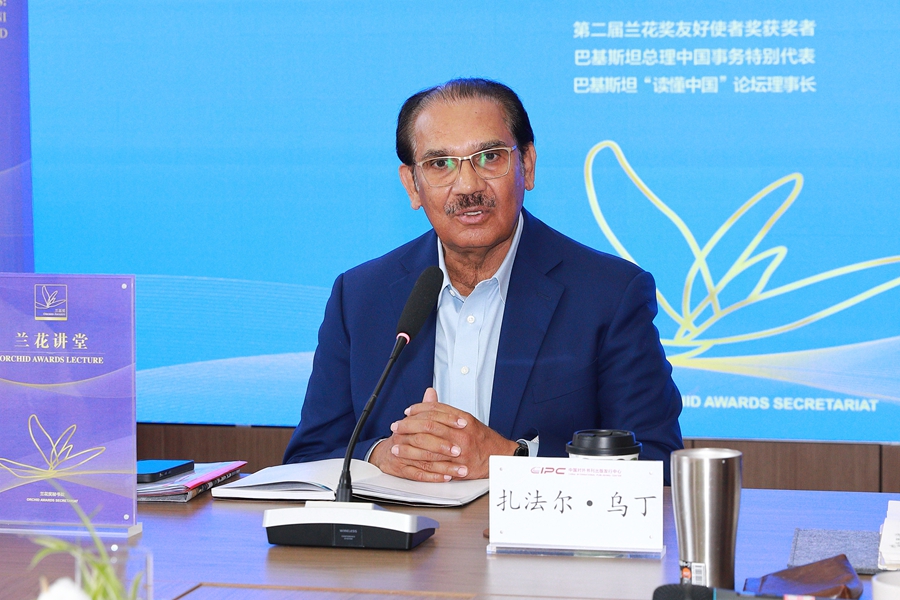 Zafar Uddin Mahmood speaks at the Orchid Awards Lecture hosted by China International Communications Group (CICG) in Beijing, March 31, 2026. [Photo provided to China.org.cn]
Mahmood was a recipient of the second Orchid Awards' Friendship Envoy prize in 2025. The Orchid Awards are an international cultural prize that honors foreigners who help the world better understand China. At the fourth session of the 14th National People's Congress in March 2026, the awards were included in the country's 15th Five-Year Plan — the first time the award has been written into a national development blueprint.
"I feel very honored," he told China.org.cn. "The Chinese government's highest body has recognized the Orchid Awards as an acknowledgement of the efforts made by foreigners to develop understanding about China and share China's real story with the world."
The Orchid Award that Mahmood received ties directly into a broader vision championed by China — the Global Civilization Initiative (GCI), which calls for dialogue and mutual learning among civilizations. Mahmood believes that the GCI carries unique weight. "The Global Civilization Initiative has a very special meaning," he said. Noting that China "has the longest written history in the world," he explained that the country embodies harmony, inclusiveness and sharing. The world today is complex and full of friction, he added, and in his view, Chinese civilization offers a model for reconciliation. The Orchid Awards given to foreigners, he concluded, are "a continuation of this civilization initiative and China's desire to make the world more peaceful and more harmonious."
Mahmood has worked closely with Chinese institutions, such as China International Communications Group (CICG). He has participated in many meaningful events led by the group, including the second Orchid Awards "Exploring China in Harbin" event and the Inter-Civilizational Dialogue Among SCO Countries 2025 in Tianjin. Though he had visited these cities before, such trips gave him a fresh perspective on both modern development and cultural history. In Harbin, he recalled, "About a hundred years ago, there were about 50% of the population was foreigners. I didn't know before that."
His motivation for founding the "Understanding China" Forum in Pakistan in 2020 was simple. "Everybody in Pakistan knows about China," he said. "Everybody considers China as the best friend. But unfortunately, they know very little beyond that." The forum has since become a platform for Pakistanis to engage with Chinese counterparts in think tanks, media and cultural fields, moving beyond slogans to genuine dialogue.
This year marks the 75th anniversary of Pakistan-China diplomatic relations. Mahmood serves on a committee formed by Pakistan's prime minister to plan the celebrations. The focus, he said, has shifted beyond government-to-government cooperation. "The objective is to convey this message of friendship to everybody in Pakistan and in China," he said. "I'm sure that this 75-year friendship will continue for another 75 years and beyond — stronger, more ironclad."
In Mahmood's view, the enduring friendship between Pakistan and China — two countries that differ in culture, religion and political system — offers a powerful example to the world. "The basic principle is what China's foreign policy says — non-interference into the affairs of the other country," he said, citing the Five Principles of Peaceful Coexistence. "I hope the whole world will follow this thing — to keep the difference aside and work unitedly for the common value."
For Mahmood, the future lies with the younger generation. He noted that tens of thousands of Pakistani students are now studying in Chinese universities. "When these 30,000 students complete their studies and go back to Pakistan, they will become the ambassadors of China in our country," he said. "They will share their stories with the people in Pakistan. This will further expand and enhance the friendship."
"I see a broad, bright future of friendship between the two countries in the years ahead," he concluded.