


How Liu Zhenyun's China Resonates with Italian Readers – An Interview with Italian Sinologist Patrizia Liberati
Fourteen years after witnessing Mo Yan's momentous journey to the Nobel Prize in Literature, Patrizia Liberati has now celebrated another milestone for Chinese literature.
The news of Liu Zhenyun winning the 2026 Italian International North-South Literary Prize had been rapidly making waves across Chinese news platforms in early spring. When asked, in an interview with China Today, for her thoughts on why Liu should be the first Chinese novelist to receive this award, the response of sinologist and translator of his works Patrizia Liberati was both droll and heartfelt: "First, because Liu Zhenyun writes brilliantly; second, because Liberati translates flawlessly – Liu Zhenyun said."
Liu, often drawing on his hometown of Yanjin in Henan Province as a source of creative and spiritual inspiration, is admired for his exploration of profound human themes such as communication, spiritual longing, and loneliness. His distinctive wit, woven into the Henan dialect, enables Liu's crafting of powerful narratives that resonate far beyond national borders. His ability to strike a poignant balance between deeply rooted local culture and the universality of human emotions and experiences reflects the timelessness of his storytelling, augmented by insightful as well as technically brilliant translations.
But how did such seemingly local dialects, colloquialisms, and the everyday struggles of everyday Henan people achieve such a strong empathy with Italian readers? According to Liberati, "Literature delves into universal themes – like the human longing for connection, the struggles we endure, and even ultimate reconciliation with life. These are timeless, universal topics that resound across cultures because, at our core, people are fundamentally the same. Naturally, these themes are presented in Liu's works through distinctively Chinese characteristics."
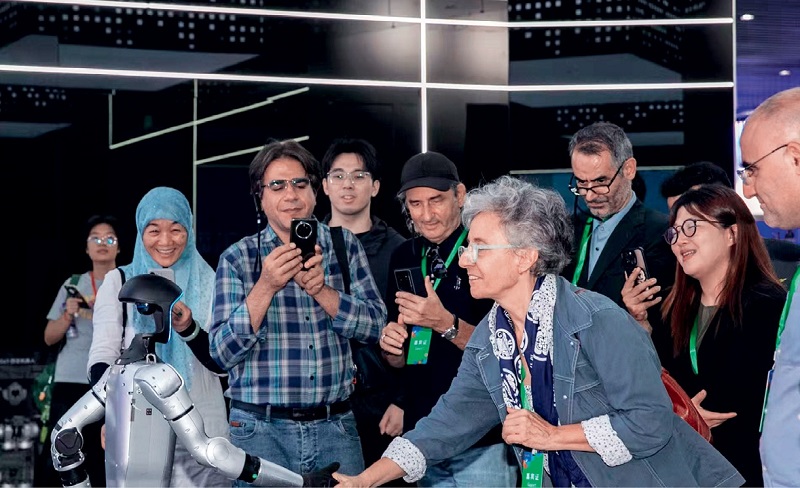
Patrizia Liberati visits Yushu Technology in Hangzhou, Zhejiang Province, in September 2025, during the China International Online Literature Week.
The "Magic Touch" of Translation
Liberati emphasizes the crucial role of translation in bridging cultural gaps, observing that a well-executed translation can both elevate a good book to new heights and utterly derail an ostensibly masterful work. As the translator concluded, "Language is immensely powerful."
Liberati's role of translating Liu Zhenyun's writings began in 2014 when she first encountered his novel, I Am Liu Yuejin. "Reading that book led to my first exploration into the lives of grassroots individuals in China, although I don't particularly favor that expression. As a foreign scholar living in Beijing, I rarely had the opportunity to engage with such groups personally. Liu's story gave me insight into their life philosophies and introduced me to a distinctively Chinese style of humor."
Liberati finds Liu Zhenyun's storytelling incredibly engaging. "He's like the traditional Chinese storyteller of the past, in that he isn't aloof. Reading Liu's work is like sitting beside him as he tells a tale, and his characters' thought processes and way of life seem to be his own. His stories envelop you."
Chinese humor is little known on the world stage, Liberati believes, "because people don't understand it." She finds it unique and intellectually stimulating. She illustrates this through the core humor of I Am Liu Yuejin, arising from the unfolding of chaos due to seemingly insignificant, random events – a domino effect of unintended actions and repercussions. This structural comedy is laden with irony, satire, and unexpected twists. In contrast to simplistic slapstick, it's a sophisticated "Liu-style humor" derived from realistic but absurd dilemmas. The protagonist, Liu Yuejin, is a resourceful, calculating, yet stubborn grassroots everyman. His humor comes from the stark contrast between his uncompromisingly practical survival logic, and the sudden, overwhelming troubles he faces. His mind set on recovering owed wages and saving money, Liu is nonetheless inexplicably drawn into a conspiracy far beyond his comprehension, and his resultant panic and clumsy maneuvering are laugh-out-loud funny. Whether focusing on the theory-spouting but absurdly incompetent thieves, the superficially fierce but inwardly hapless gang leader, or the sanctimonious, panic-stricken officials, Liu Zhenyun depicts their ludicrous and pitiful aspects with concise, bold strokes. The antics of these characters in their pursuit of gain create a rich tapestry of satirical comedy.
"We can see that Liu Yuejin's character is very persistent; he's tenacious, and never gives up. This also reflects a characteristic of a certain social group in China."
Liberati later translated other works by Liu Zhenyun, including The Children of the Melon-Eating Era, One Day, Three Autumns, and the award-winning Someone to Talk To. She is currently working on his latest novel, Salty Jokes: Am I Supposed to Laugh?, published in 2025.
"One of the things that captivates me about Liu's works is that of their layered storytelling structures, which are brilliant and thought-provoking," Liberati said. "His works don't just showcase creative narration; they delve into philosophical exploration, making readers reflect on life, society, and themselves," she added.
Translating the Henan dialect and culturally specific details embedded in Liu's works proved both a challenge and an enriching experience for Liberati. "I pester Liu Zhenyun daily during translation!" she admitted. "Face-to-face discussions really help. When I encountered expressions I didn't understand, we sat down for long conversations whereby Liu provided thoughtful explanations." When she told him she had no idea what hulatang (spicy pepper soup) and huimian (braised noodles) are, which both appeared in his books, Liu took her out to try them. Liberati said that her understanding of certain expressions in the Henan dialect in his books occurred when she heard him speak it in person. "When you see him, hear him speak the dialect, and see his facial expressions, the meaning in the book becomes instantly clear."
Liberati believes a good translator should convey the original flavor and style of the work. "For example, when translating idioms and proverbs, I try to find corresponding expressions in Italian. It's quite magical how these two ancient languages often echo each other, like when Liu Zhenyun says,'Give time some time,' we have an exact equivalent in Italian." In tackling translation of the Henan dialect, therefore, she strives to use authentic, colloquial Italian expressions.
"I don't feel I've adapted Liu Zhenyun's works through use of Italian; my translations are faithful to the original. I just try my best, linguistically and lexically, to achieve the same expressive effect as that in Chinese. That is, the translation should create for Italian readers the same feeling that Chinese readers get from the original. If I can achieve that, I consider myself successful," Liberati told China Today.
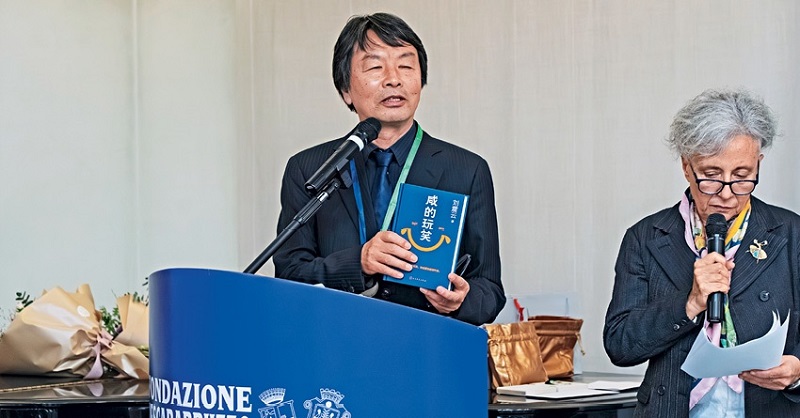
Liu Zhenyun delivers a speech at the award ceremony of the 2026 Italian International North-South Literary Prize in Italy on February 20, 2026, in the company of Patrizia Liberati, who has been instrumental in bringing his works to Italian readers.
A Messenger for Sino-Italian Literary Exchange
Liberati's translation repertoire extends beyond Liu Zhenyun. Her introduction to translating contemporary Chinese literature began with Mo Yan's Sandalwood Death in 2003. "I loved this book so much. I simply couldn't put it down. The characters, the history, the setting, the ideas – everything about it captivated me."
At that time, she was working closely with Maria Rita Masci, one of Italy's most renowned translators. Having translated many works by vibrant contemporary Chinese authors who were active in the 1980s and 1990s, Rita was also Liberati's mentor. It was due to her encouragement that Liberati contacted the author Mo Yan and an Italian publisher, translated the book, and saw it published in Italy. Subsequently, Liberati also translated Mo Yan's Life and Death Are Wearing Me Out; Change; Frog; and Pow!. She has also, through translation, brought classic works by Jia Pingwa, Wang Xiaobo, and Jin Yong to Italian readers. In 2012 she, along with translators of Mo Yan's works in other languages, accompanied him to Stockholm to receive the Nobel Prize in Literature.
"Through these works, Italian readers come to the realization,'Oh, so Chinese people live pretty much like us.' I hope that through my translations readers can both savor the works' exotic flavor and find a rapport. I don't think understanding a foreign culture should consist in dry, detached observations, like those gained from looking through a magnifying glass, because that deprives the reader of joy in shared humanity. To discover that people everywhere are fundamentally the same, you need to immerse yourself in every aspect," Liberati said.
On February 20, the 15th jury of the Italian International North-South Literary Prize decided to award this accolade to Chinese author Liu Zhenyun, citing the reason: "For the unique philosophical insight and humor in his works, which have profoundly influenced readers across multiple languages." This places the name of a Chinese novelist in the global literary spotlight once more, in the wake of Mo Yan.
"Often, readers seek empathy in books. One of a writer's tasks is to make readers feel less alone in the world, because the problems people face are basically same. That's why I feel that Liu Zhenyun's works, despite their Henan dialect and local characteristics, are international because the themes he explores are indeed universal. For instance, the deep spiritual needs of people as revealed in Someone to Talk To are common to all humanity," Liberati said.
In her view, another profound takeaway for readers of Liu Zhenyun is witnessing "how Chinese people live as human beings.""The kindness, warmth, sense of justice, gallantry, and the millenniaold etiquette that define Chinese culture – these are traits seldom found elsewhere. In particular that which we call renqingwei – that deeply human touch – which is something that industrialized societies like Italy's would do well to savor and learn from."
Throughout her translation work, Liberati has also observed numerous historical connections and socio-cultural similarities between China and Italy. "In Someone to Talk To, Yang Baishun hopes to keep his son by his side to make tofu. This is very Italian. In Italy, if a father is a dentist, he generally hopes that his son will follow in his footsteps, and the same goes for a father who is a painter." She believes this might stem from both Chinese and Italian civilizations being ancient and profound, with deep-rooted traditions and continuities.
Even the Henan countryside depicted by Liu Zhenyun feels familiar to Liberati. "My grandmother lived in the Italian countryside, a way of life similar in many ways to that in rural China."
In view of the historical ties between the two civilizations, Liberati feels that the mutual appreciation of one another's culture is natural. "During the recent Winter Olympics, we saw many Chinese people lining up for visas at the embassy. And many Chinese friends told me how fantastic the Italian Winter Olympics were. There can be no doubt that there is a strong rapport between Chinese and Italian people," Liberati said.
Historically, it was such figures as Marco Polo, Matteo Ricci, and Giuseppe Castiglione that came to China and introduced the Middle Kingdom to the West while familiarizing China with Western civilization. "These historical connections have piqued Italian people's fascination with various aspects of Chinese culture, such as its architecture and poetry, as well as the Great Wall, emblematic as it is of the Chinese civilization."
Liberati has also noted the deep knowledge many Chinese children have about Italy, especially its historical sites, whereas Italian children know comparatively little about China. "This is precisely where we need to focus our efforts. Currently, there are 13 Confucius institutes in Italy, and Chinese is taught in over 20 middle and high schools, with a growing trend."
She hence sees enormous potential in Sino-Italian literary exchange. In 2024, Liberati accompanied Liu Zhenyun on a tour of five Italian cities, including Rome, Milan, and Turin, to promote Someone to Talk To. The receptions were enthusiastic. "Each event attracted hundreds of attendees, many of whom asked relevant questions. The events were covered by Italy's national television as well as prominent media outlets."
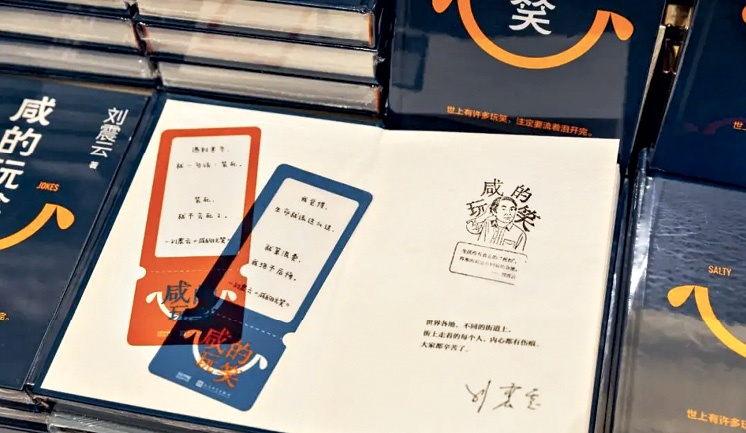
Liu Zhenyun's latest work Salty Jokes: Am I Supposed to Laugh?
"The World is Now Looking at China"
"In Italy and many other countries, people's eyes light up when they hear I live and work in China. Many say they want to visit," Liberati said.
Now in her sixties, Liberati has a profound understanding of the shifts in global trends. "When my parents were young, their ideal country was America, because the world was just emerging from WWII. When I was young, British rock music was sweeping the globe, so the U.K. was my choice. My youngest two daughters, now adults, meanwhile, grew up listening to K-pop. But now, I find everyone is looking at China."
Liberati cites the growing global influence of Chinese brands, as well as its AI industry and video games. "We once visited a Chinese video game company. The characters from the Romance of the Three Kingdoms, the elements of Chinese ink-wash painting, and the Taoist mythology they incorporated into their games, much like the globally popular Black Myth: Wukong, are extremely popular among foreigners."
Liberati's own connection with China dates back to 1986 when she enrolled in the Chinese department at School of Oriental and African Studies (SOAS), University of London. In 1987, through an exchange program between SOAS and Beijing Normal University, she came to China for the first time, and also met her future husband.
In her view, due to the similarities between Chinese and Italian cultures, she and her husband share similar attitudes towards many aspects of life and family. What touches her most about the Chinese people is their warmth, loyalty, and strong sense of human connection. "In Italy, seeing an old friend of my parents approaching our building with bags, my husband would without hesitation run down to help carry them up. This is particularly admirable and endearing, embodying the Chinese cultural trait of'respecting the elders of others as one respects one's own.'"
Having lived in China since 1990, Liberati, despite her Italian appearance, feels very much like a Chinese person. She thoroughly enjoys her life and work in China. Since the late 1990s, she has worked at the Italian Embassy in Beijing. "I find Chinese life very solid, very down-to-earth. Chinese emotions are profound. It might take some time to become friends with a Chinese person, but once they trust you, it's for life. Years later, if you seek them out, they will still do everything they can to help you."
What fascinates Liberati most about China now is the layering of tradition and modernity. "For example, in Sanlitun, while surrounded by skyscrapers, you might suddenly come across an elderly woman selling tea eggs. Another time, in Songyang, Zhejiang, we saw two farmers using a large drone to plant bamboo on a high slope." The rapid development of the economy and technology hasn't led people to disregard tradition, and the millennia-old Chinese civilization continues to imbue contemporary Chinese society with its unique spiritual essence and charm.
Beyond translating literature, since 2014, Liberati has been the editorial director and translator for the Italian edition of People's Literature magazine. She is proactive in seeking ways to promote Chinese literature in Italy and cultivate and encourage young translators. Liberati and her colleagues primarily encourage young translators in two ways: through translation contests where winners can have their stories published in the magazine, and "secondly, by including our translations as required reading for Italian university students learning Chinese. Having them read our work isn't just for them to learn from our translations; it's for them to look at our translations critically. They can express doubts about our choices and find different ways to translate. It is also a very interesting way to connect intellectually."
Liberati feels that one significant reason Italians know relatively little about China is "a lack of translations.""And that is precisely what we should be working on," she concluded.