


Sichuan Opera
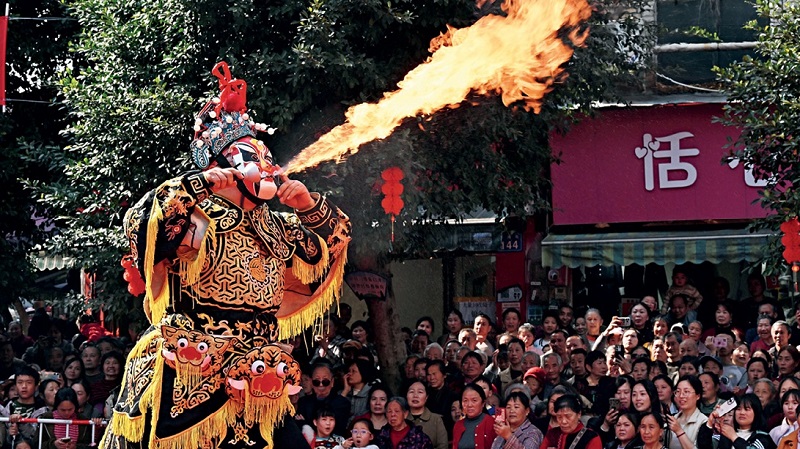
An artist showcases the Sichuan Opera stunt of fire-spitting in Neijiang City, Sichuan Province on February 25, 2026.
Sichuan Opera is the most influential regional opera genre in southwestern China. It took shape between the late Ming (1368-1644) and the mid-Qing (1644-1911) dynasties and has long been a beloved folk art among the people of Sichuan, Yunnan, Guizhou, and other southwestern provinces. In 2006, Sichuan Opera was inscribed on the first list of China's national intangible cultural heritage items.
In terms of vocal styles, Sichuan Opera is a synthesis of four major Chinese singing systems – Gaoqiang (high-pitched), Kunqiang (Kunqu Opera-style), Huqinqiang (Pihuang vocal style), and Tanxi (Plucked String Opera) – combined with a local folk performance form known as Lantern theater. The repertoire of Sichuan Opera is extremely rich, consisting of more than 6,000 traditional and contemporary plays. Themes exhibited during performances are closely connected to everyday life.
Similar to other forms of Chinese opera, Sichuan Opera also features distinct role types, including young male roles, female roles, male roles, painted-face roles, and clown roles. Each role type has its own well-developed system of techniques and performance conventions.
Sichuan Opera performers have developed many unique stunts to better portray their characters. These include chair acrobatics resembling martial arts performances, thrilling fire acts such as fire play and fire breathing, and the widely known face-changing performance. These dramatic and visually striking skills have become a hallmark of Sichuan Opera.
In addition, various types of movements during a performance are executed purely with physical gestures without props. For example, hand, eye, body, and foot gestures are used to convey actions such as picking a flower, opening or closing a door, or going up and down stairs, relying on the viewers' imagination to understand the scene.
Facial makeup is another key element used to express each character's personality. Unlike other opera traditions, Sichuan Opera does not employ professional makeup artists to paint masks. Instead, each actor paints their own facial mask, thus preserving the essential characteristics of each role while creatively adapting the designs to suit their own performing style.
In recent years, Sichuan Opera has gained renewed vitality through the combined efforts of preservation and innovation. With policy support from national and local governments, professional troupes at various levels have established master artist studios, implemented training programs for young performers, and conducted promotional activities in schools to continuously expand the young talent pool.
While preserving traditional repertoires and conventions, Sichuan Opera performers have also actively explored modern themes and innovative ways of performing the art. By combining classical artistic traditions with contemporary aesthetics, they have increased its appeal to younger audiences. In recent years, Sichuan Opera artists have frequently appeared at national arts events, demonstrating the vitality and potential of traditional Chinese opera in the modern era.