


Sichuan Museum: A Treasure Trove of Ancient Relics
Sichuan Province, which was called Shu in ancient China, boasts a long history, with records of human activity dating back two million years. The region is home to a rich cultural heritage, including the splendid Bashu culture and the renowned Three Kingdoms culture. Particularly remarkable is the mysterious ancient Shu civilization, represented by the Sanxingdui and Jinsha archaeological sites.
Located in the province's capital city Chengdu, the Sichuan Museum houses more than 360,000 cultural relics, including 1,318 first-grade historical artifacts under state protection. Among its most celebrated pieces are: the Neolithic Human-Face Jade Pendant, the Bronze Pot with Water-and-Land Battle Scenes, the Later Shu Stele Carved with the Book of Songs, and the Tang Dynasty Seven-String Zither, "Knocking Ice in a Mountain Stream."
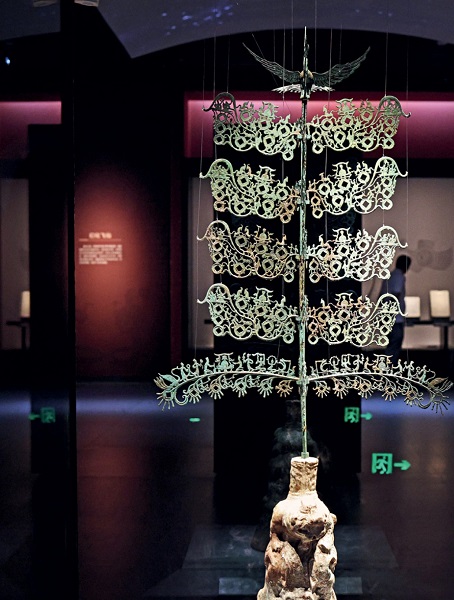
The Money Tree from the Eastern Han Dynasty on view at the Sichuan Museum.
An Ancient "Emoji"
The Neolithic Jade Pendant with a Human Face was unearthed in 1959 from a child's tomb at a Daxi culture archaeological site. Dating back around 6,000 years, the artifact offers a rare glimpse into the mysteries and symbols of early civilizations.
Archaeologists have determined that the tomb from which the pendant was excavated dates back to approximately 5,000 to 6,000 years ago, linking it to the late Daxi culture period. This discovery marked the first known stone-carved human facial image from China's Neolithic era, providing a valuable physical artifact for studying jade craftsmanship and cultural symbolism during the late Neolithic period.
It is a black, egg-sized and oval-shaped object made from fine-textured volcanic tuff, measuring 6 centimeters in length, 3.6 centimeters in width, and 1.6 centimeters in thickness. The most striking feature of the artifact are the carefully carved human faces on both sides, each with a slightly mysterious expression.
One side of the pendant shows a full and rounded face, while the other appears thinner and more angular. The nose bridge is high, the eyes are wide open, with the mouth forming an "O" shape. Around the face are irregular carving marks left during the production process. Despite its simple and primitive carving style, the piece conveys a vivid sense of life.
According to Yin Hong, a curator at the Sichuan Museum, the jade face likely served as a decorative element of a pendant. "At the top of the jade piece are two perforations, indicating it was probably suspended, which is why it has been identified as a jade pendant," she explained.
As for its function, experts have offered different interpretations. Some believe it may have been an early toy, while others suggest it might have served as an amulet.
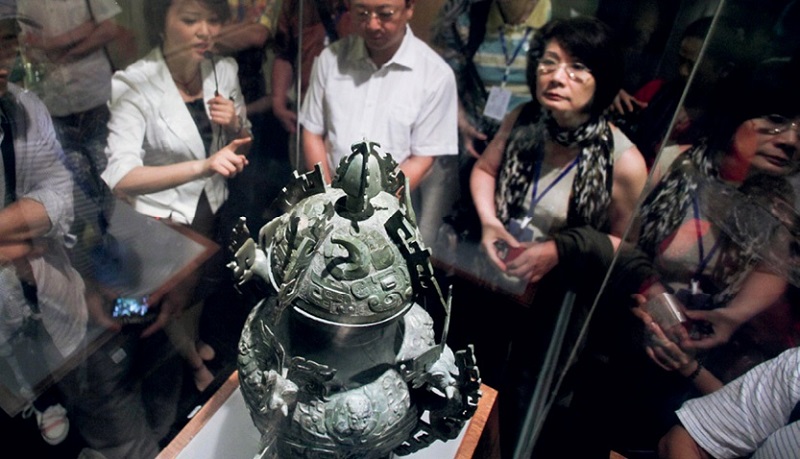
A guide introduces the Western Zhou Dynasty (1046-771 B.C.) Bronze Lei Wine Vessel with a Beast-mask Motif to a crowd of visitors at the Sichuan Museum.
Bronze Vessel with the Design of Land and Naval Battle Scenes
Another treasure of the museum is the Bronze Pot with Water-and-Land Battle Scenes, dating back to the Warring States period (475-221 B.C.).
With the passing of many centuries, some of the images engraved on the bronze vessel have become faint. However, with the help of visual reconstructions on display panels and explanatory videos, visitors can experience visually scenes of warfare and daily life in the ancient Shu State.
The bronze pot stands 40 centimeters high, with a mouth extending 13.4 centimeters in diameter, and an abdominal diameter of 26.5 centimeters. The figures engraved on the surface are divided into four sections by three rings, portraying more than 200 human figures engaged in activities such as hunting, mulberry picking, banquets, and land and naval warfare.
Unlike the mysterious and symbolic patterns typical of the Shang (1600-1046 B.C.) and Zhou (1046-256 B.C.) dynasties, the imagery here depicts scenes of everyday life, marking a shift from mythological themes to a more realistic representation of human society.
Naval forces began to emerge in China during the late Spring and Autumn period over two millennia ago in regions near rivers and seas. Archaeologists have discovered very few artifacts related to naval warfare during that period, making the depiction of naval battle scenes on this vessel invaluable for historical research.
The bronze pot also reveals the established sericulture (silk farming) industry that existed during the ancient Shu era. One scene shows people gathering mulberry leaves: two mulberry trees with lush foliage stand at the top, with people picking leaves, while others carry the leaves in baskets below. Another figure sings and dances to entertain the workers. This scene provides visual evidence of the thriving silk production industry in the Sichuan region.
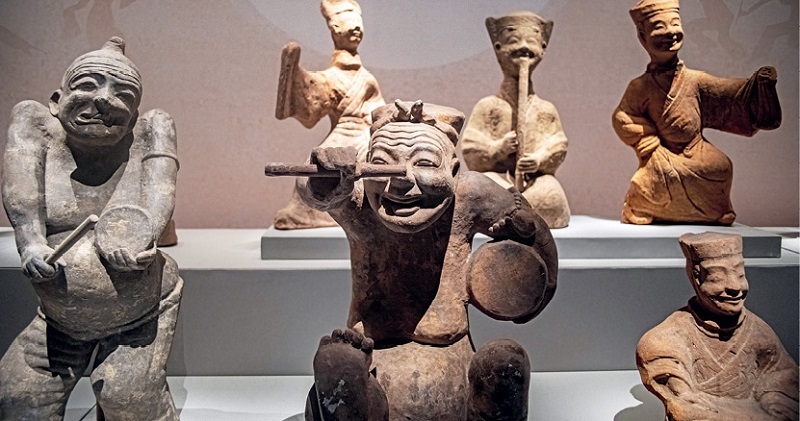
A replica of The Storyteller Figurine Eastern Han Dynasty (25-220) at the Sichuan Museum.
A Stone Confucian Textbook
Another must-see exhibit is the Fragments of the Later Shu Stele Carved with Zhou Songs and Lu Songs from the Book of Songs.
The Later Shu steles carved with Confucian classics can be regarded as one of China's earliest textbooks. During the Five Dynasties period (907-960), the Later Shu emperor Meng Chang (919-965) promoted culture and education by initiating a massive project to engrave Confucian classics onto stone tablets.
The inscriptions contain more than 1.4 million characters, making them the most extensive among all stone classics in Chinese history. These stone tablets were originally placed in the Chengdu Academy, the highest educational institution in the Sichuan region and the earliest local government-run school in China, which is today's Chengdu Shishi High School. Students studied and copied the texts from these inscriptions.
After the Song Dynasty (960-1279), these steles became an authoritative reference for publishing Confucian classic teachings and served as textbooks for official schools across China.
These stone textbooks also helped establish the basic structure of the Confucian classic system. They were the earliest stone inscriptions to include the text of Mencius and the first to compile what later became known as the Thirteen Classics – classics of Confucian traditions – in a single collection. This achievement had a profound and lasting influence on Chinese cultural history.
The inscriptions also included commentaries alongside the original texts, making them easier to study and interpret – an innovation in the dissemination of Confucian learning.
The Sichuan Museum currently holds six fragments of these stone classics, including inscriptions from the Book of Songs, the Book of Changes, the Book of Documents, and others. The piece on display at the museum features inscriptions from the Book of Songs: one side contains "Zhou Song" with ten remaining lines, while the other side contains "Lu Song."
A visitor photographs the Bronze Human Head from the Shang Dynasty (1600-1046 B.C.) on display at the Sichuan Museum.
A Tang Dynasty Zither
In traditional Chinese culture, guqin ranks first among the four arts of the Chinese scholar – guqin (a stringed instrument), chess, Chinese calligraphy, and Chinese painting.
Today, only about 20 Tang Dynasty (618-907) guqins survive worldwide. The "Shi Jian Qiao Bing" seven-stringed zither preserved in the Sichuan Museum holds the position as crown jewel due to its excellent condition and rich, resonant sound.
The instrument measures 122.7 centimeters in length, with a wider head and narrower tail, forming smooth and elegant lines. It embodies the classic style of Tang dynasty guqin craftsmanship. The slightly curved soundboard is decorated with 13 circular mother-of-pearl markers, symbolizing the relationship between musical tones and celestial patterns.
On the underside are two sound holes known as the "Dragon Pool" and "Phoenix Pond," symbolizing the harmony of heaven and earth and reflecting the ancient Chinese philosophy of the unity of humanity and nature. The four characters "石涧敲冰" (Shi Jian Qiao Bing) engraved in cursive script on the underside of the instrument suggest that its sound resembles the crisp resonance of jade or metal striking ice. Natural cracks in the lacquer surface cover the instrument's body – a sign of its great age and evidence of a traditional lacquer technique used during the Tang Dynasty.
Historically, the Sichuan region was renowned for producing some of the finest qin in China. This instrument embodies the peak craftsmanship of that era and has passed through the hands of collectors from the Liao Dynasty (907-1125) through the Qing Dynasty (1616-1911), adding further historical and cultural value.
Public Education
The Sichuan Museum also actively fulfills its public education mission. It has launched several programs such as a museum education research institute, a mobile museum, and a school-museum alliance, creating new models for cultural and educational cooperation and building an inclusive museum education system for people of all ages, regions, and communities.
In recent years, the museum has developed over 200 educational courses and more than 20 study routes, while training 916 young volunteer guides. The mobile museum event has brought exhibitions directly to communities, effectively turning neighborhoods into accessible museums. With 71 member institutions nationwide, the initiative has reached over two million visitors, making high-quality cultural resources accessible at the community level.
In addition, the museum has established 17 conservation laboratories and restoration studios, covering an area of 1,600 square meters. These facilities undertake more than 70 percent of the conservation planning and implementation for movable cultural relics in Sichuan Province, playing a vital role in the protection of local cultural heritage.