


China-Mexico cooperation lights a green path for the Global South
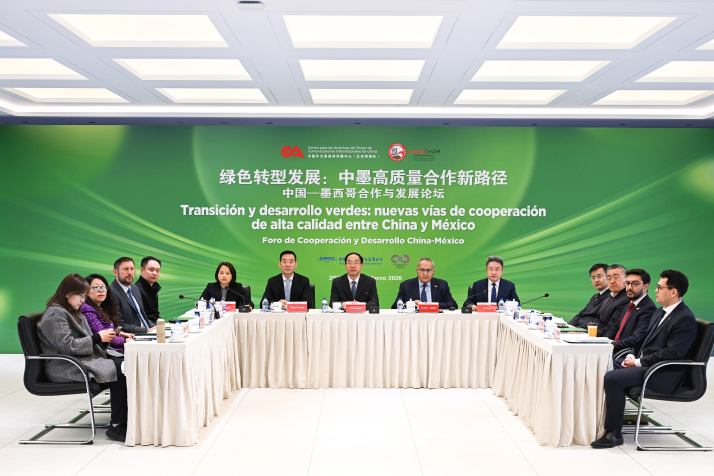
Participants at the Beijing venue of 2026 China-Mexico Cooperation and Development Forum on March 10. [Photo/CICG]
In the deserts of Sonora in northwestern Mexico, rows of solar panels stretch across the horizon, bringing an end to power shortages that once limited both daily life and local development. For local communities, the panels are a source of reliable electricity, but for observers of international cooperation, they represent something larger: the growing role of China-Mexico cooperation in advancing green development.
The Puerto Peñasco photovoltaic power plant in Sonora, which began operation in 2023 and is being built with the participation of multiple Chinese companies, is gradually reshaping the region's energy landscape. Its second phase alone has an installed capacity of 300 megawatts and can generate more than 2 million kilowatt-hours of electricity a day, enough to power 200,000 households.
As countries around the world accelerate their energy transitions, collaborations such as this one, between two major developing economies, are increasingly being viewed as examples of how Global South nations can work together to pursue sustainable growth.
Against this backdrop, discussions at the 2026 China-Mexico Cooperation and Development Forum reflected how the two countries are finding common ground on sustainability initiatives and actions.
The forum, themed Green Transition: Charting a New Path for High-Quality Cooperation, was held on March 10, bringing together participants in both Beijing and Mexico City venues. It was co-hosted by China International Communications Group (CICG) Center for the Americas and the China Chamber of Commerce and Technology Mexico.
A shared vision
At a time when green development has become a central theme in global policy agendas, China-Mexico cooperation is gaining fresh momentum.
In China, the annual Two Sessions, the meetings of the National People's Congress (NPC), the top legislature, and the Chinese People's Political Consultative Conference (CPPCC) National Committee, the top political advisory body, have drawn global attention to the outline of the country's 15th Five-Year Plan (2026-30).
The plan emphasizes accelerating the green transition across the board, calling for coordinated efforts to cut carbon emissions, reduce pollution, pursue green development and boost economic growth, while strengthening green development drivers.
Noting that China has positioned green development as a national strategic priority, Yu Yunquan, CICG Vice President, called for stronger China-Mexico cooperation in green development. As members of the Global South with shared aspirations for sustainable growth, he said collaborative efforts could bring substantial benefits to both countries.
Strong potential exists in three areas: building platforms for technological innovation, aligning green finance standards to facilitate cross-border investment and expanding new-energy vehicle partnerships, according to Yu. From trade to industrial collaboration, China and Mexico have forged a model of win-win cooperation for Global South countries, Yu added.
Mexican Ambassador to China Jesús Seade also pointed to the strong convergence in the two countries' approaches to green development. China is advancing efforts to reach peak carbon emissions before 2030 and achieve carbon neutrality before 2060. Mexico, meanwhile, is pursuing an ambitious energy transition strategy aimed at generating 35% of its electricity from clean sources by 2030. These parallel efforts, he noted, create opportunities for cooperation in renewable energy, electric mobility and green technologies.
From policies to projects
Some of the areas mentioned by the ambassador have emerged as the most dynamic areas of collaboration between China and Mexico.
Chinese enterprises have increasingly participated in photovoltaic power stations, electric vehicle projects and digital energy systems across Mexico, according to Wang Xinming, counselor at the Department of Latin American and Caribbean Affairs of China's Ministry of Foreign Affairs."These projects demonstrate that China-Mexico green cooperation is moving from conceptual consensus to tangible outcomes," he said.
The Puerto Peñasco photovoltaic power project stands as a prominent example. Once completed, the plant will considerably expand Mexico's renewable energy capacity while helping reduce dependence on imported electricity. Chinese electric vehicle (EV) brands are also playing a larger role in Mexico's green transportation sector.
EVs produced by Chinese manufacturers, particularly BYD, have gained increasing popularity in Mexico due to their relatively affordable prices compared with many other international EV brands. Around 85,000 BYD vehicles were sold in Mexico last year, accounting for roughly one third of all Chinese-branded vehicle sales in the country.
Industry observers note that vehicles made in China are attracting Mexican consumers not only because of their competitive pricing, but also because of their solid manufacturing quality, according to Mexico News Daily.
Speaking at the forum, Chinese Ambassador to Mexico Chen Daojiang underscored the importance of closer alignment of development strategies between China and Mexico. While consolidating cooperation in traditional areas such as trade, investment and infrastructure, he said, China is willing to expand collaboration with Mexico in emerging fields including the digital economy and green, low-carbon development.
He Peng, Deputy Director of the CICG Center for the Americas, shared a similar view, noting that China's strengths in technology, industrial capacity and market scale complement Mexico's advantages in geographic location, natural resources and industrial foundations.
A new development model
The global energy transition is reshaping industrial structures and economic systems worldwide. For many developing countries, the challenge is not only how to industrialize, but how to do so sustainably. In this context, collaboration between emerging economies may offer valuable lessons.
Sui Jigang, a researcher at the Institutes of Science and Development at the Chinese Academy of Sciences, argued that technological innovation will play a decisive role in helping developing countries achieve sustainable industrialization. Traditional growth models based on heavy resource consumption are increasingly unsustainable. A new development pathway, one that combines technological advancement with ecological conservation, is gradually taking shape.
China's experience in promoting green innovation, he suggested, could provide useful experience for other developing economies seeking to balance growth and sustainability.
Business leaders share a similar view. Vicente Roqueñí López, Executive President of the China Chamber of Commerce and Technology Mexico, believes the global transition to clean energy is rapidly evolving from a policy objective into a powerful driver of economic growth. Cooperation between China and Mexico in renewable energy and green industries could therefore generate great strategic value.
At the same time, the participants emphasize the importance of intellectual exchange in deepening cooperation. Mexican economist Enrique Dussel Peters, Director of the China-Mexico Studies Center at the National Autonomous University of Mexico, called for stronger academic dialogue between China and Latin America. Such exchanges can help policymakers and researchers better understand development strategies and identify new areas for collaboration, according to him.
Together, the participants' perspectives point toward a broader conclusion: China-Mexico cooperation is gradually evolving into a platform for exploring sustainable development models that could benefit the wider Global South.