


Annual report maps the frontiers of China's language services industry
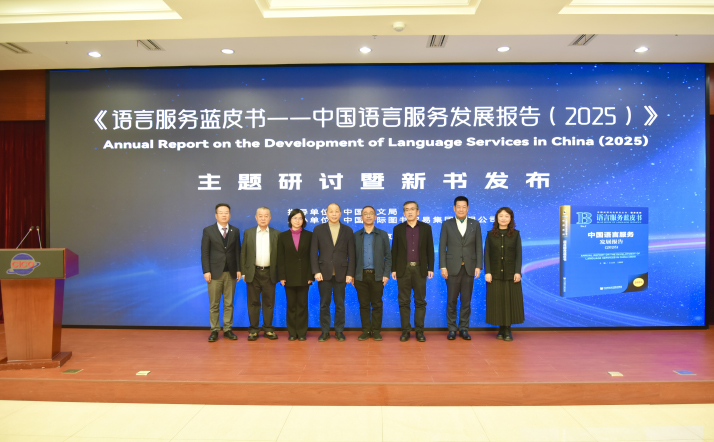
Participants pose for a group photo at the thematic seminar and book launch event for the Annual Report on the Development of Language Services in China (2025) in Beijing on January 26 (COURTESY PHOTO)
Faced with an outbreak of the Chikungunya virus in China's Macao Special Administrative Region in the second half of 2025, local tertiary institution Macao Millennium College (MMC) developed an intelligent consultation platform allowing users to switch voice prompts between Standard Chinese, Cantonese, English and Portuguese with just one click. Designed to enhance the timeliness and accuracy of epidemic response, the platform enables direct cross-language communication using standardized audio.
The platform is just one of the many digital-intelligent language service solutions developed by MMC in recent years. At the end of 2024, the college introduced a multilingual intelligent communication platform for earthquake relief, which provided real-time translation between Chinese, English, Burmese and Thai during disaster relief operations in Myanmar, helping emergency instructions overcome language barriers.
At the thematic seminar and book launch event for the Annual Report on the Development of Language Services in China (2025), held in Beijing on January 26, Zhong Weihe, President of MMC, said AI and big data are profoundly reshaping the paradigm of language services, driving the industry from "human translation" toward a new era of "intelligent services." Against this backdrop, MMC has pioneered the concept of digital-intelligent language services, elevating these services from a supportive tool to strategic infrastructure for preserving civilizational diversity.
Speaking at the event, Xie Gang, Vice President of China International Communications Group, highlighted that language services are embracing new opportunities in areas such as the precise dissemination of Chinese civilization and the transformation of traditional culture.
Xie recognized the recent progress of specialized language service export bases and called on the industry to further integrate into national strategies.
World of words
The annual report examines the development of China's language services industry in 2024-25. It shows that the industry's total output value surpassed 248 billion yuan ($36 billion) in 2024, with over 1.25 million enterprises and a workforce exceeding 2.07 million. Business types had become increasingly diversified and market competition remained intense.
Wang Lifei, a professor at Beijing Language and Culture University and executive editor of the report, said at the event that driven by both policy support and technological evolution, China's language services industry continues to expand in scale and is advancing toward high-quality development. AI has become deeply integrated into the sector, giving rise to new models of human-machine collaboration.
Emerging fields such as intelligent language services, emergency language services and cross-border e-commerce language services are experiencing robust growth. He recommended incorporating language services into strategic emerging industry development plans, building digital infrastructure, promoting integrated models of language services and accelerating the establishment of professional certification and quality standard frameworks. These steps, he argued, are essential to better leverage the industry's role in providing strategic support for international cooperation and communication.
Taking the medical language services sector as an example. Zhu Shan, an associate professor at Beijing International Studies University, notes in the report that frequent global population movements have significantly increased the reliance on language services in healthcare. In multilingual environments, effective communication is vital in improving diagnostic and treatment efficiency; for instance, the standardized translation of medical records is crucial for ensuring accurate treatment and nursing and patient safety. Furthermore, in bilateral and multilateral medical cooperation initiatives and international patent applications, language services play a vital role in overcoming cross-cultural barriers.
This is particularly true in the field of traditional Chinese medicine (TCM). The depth of the culture surrounding TCM principles and practices has led its internationalization to drive the development of TCM language services into an interdisciplinary field. Its core mission has shifted from merely removing language barriers toward building a cross-cultural interpretative community.
"Equating the language services industry solely with translation and interpretation is a common oversimplification. In reality, the industry encompasses a broad spectrum," Wang said at a forum on language services development on April 24, 2025. Language services for the elderly stands out as a field that distinctly embodies the integration of AI-powered efficiency with human-centered warmth.
As highlighted in the annual report by Gu Wenjin, a postgraduate student at Beijing Language and Culture University, elderly language services leverage linguistic capabilities and information technology. They aim to meet the diverse needs including daily care, medical rehabilitation, education and cultural activities by providing a range of assistances including language communication, psychological comfort and cognitive support.
By 2024, China's population aged 60 and above had exceeded 290 million, generating rapidly growing demand for elderly language services. The report highlights an urgent need for professionals with expertise in both assistive technology and speech therapy, emphasizing that the emotional companionship integral to these services remains largely irreplaceable by digital means. Closely linked to the elderly care and healthcare sectors, this emerging field integrates into and enriches the broader industrial ecosystem. High-quality language services not only tangibly improve the quality of life for senior people but also drive technological innovation across related industries.
Future prospects
In the report, Wang points out that the language services industry currently faces multiple challenges, including a fragmented market landscape, low industry concentration and insufficient research and development investment by small and medium-sized enterprises. Although the penetration rate of AI in the industry has reached 97.1 percent, it still falls short in areas such as accuracy and handling cultural nuances.
Furthermore, the development of language services is uneven across different regions, with economically developed areas like Beijing, Shanghai and Guangdong Province accounting for an absolute majority of enterprises in the industry. The shortage of language service providers in central and western regions constrains their level of industrial internationalization.
He stresses that the industry's development requires interdisciplinary professionals with combined competencies in language proficiency, AI and extensive knowledge across multiple fields. However, the talent cultivation system in China's higher education institutions has not yet fully aligned with market demands, leading to a scarcity of high-end professionals. Additionally, there is insufficient recognition of the strategic value of language services as fundamental infrastructure for international communication and trade, which limits the scale of the industry's expansion.
To address these issues, Wang proposes encouraging private capital to enter this field to enhance industrial concentration and market competitiveness, cultivating new-type intelligent language services talents with comprehensive skills, and establishing a collaborative talent development mechanism involving industries, universities and research institutes.