


Ningxia Museum
At the Ningxia Museum, visitors can dive into the history of the mysterious Western Xia Dynasty, as well as cultural and ethnic exchanges that occured along the ancient Silk Road centuries ago.
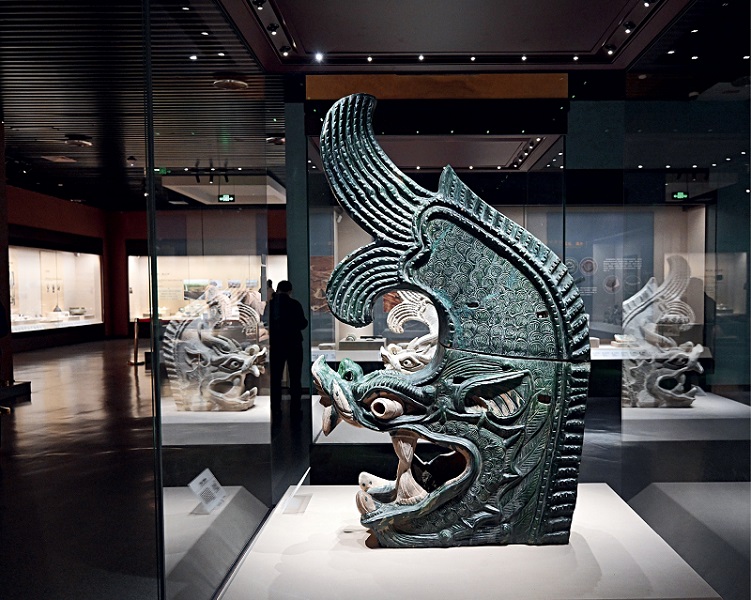
The Green-Glazed Chiwen (roof ridge ornament) on display at the Ningxia Museum.
The area of present-day Ningxia Hui Autonomous Region in northwest China was a vital corridor of the ancient Silk Road. Around a thousand years ago, Yuan Hao, leader of the Tangut people, established the Western Xia (also known as Xixia) Dynasty (1038-1227) on this land, which coexisted with the Song, Liao, and Jin dynasties across China for nearly 200 years. In addition to the Tangut, the realm was home to many other ethnic groups, including the Han, Tibetan, Uygur, and Tatar peoples. In 1227, the Western Xia was conquered by Genghis Khan's Mongol troops, after which the dynasty gradually faded into history.
The Xixia Imperial Tombs lay in silence for over 700 years until coming to the attention of archeologists in 1972. As the largest, highest-ranking, and most well-preserved archaeological site from the Xixia period, the complex comprises nine imperial mausoleums, 271 subordinate tombs, a northern architectural complex, and 32 flood control structures.
In 2025, the Xixia Imperial Tombs were inscribed on the UNESCO World Heritage List. The World Heritage Committee recognized the site's important role in cultural and commercial exchanges along the Silk Road during the 11th to 13th centuries, which had fostered communication and collaboration among various ethnic groups.
Numerous artifacts excavated from the site are now housed in the Ningxia Museum in Yinchuan City, capital city of Ningxia. The institute boasts a collection of over 50,000 cultural relics, including 157 first-class artifacts. Among these, the Gilded Bronze Ox, the Strongman-shaped Stone Pedestal with Inscriptions, and the Stone Gate Depicted with Sogdian Whirl Dancers have been designated as national treasures.
Gilded Bronze Ox
The Gilded Bronze Ox, unearthed from a noble's tomb in the Xixia Imperial Tombs, is a bronzeware masterpiece.
The ox, measuring 130 centimeters in length and 38 centimeters in width, is down on its knees and gazing calmly forward. The neck muscles are clearly defined and a strong spine can be seen running from the neck to the tail. Although hollow inside, the sculpture weighs 188 kilograms.
This iconic item was crafted using a range of techniques during the shaping, casting, polishing, and gilding processes. This spectacular craftsmanship explains why, after more than a thousand years underground, the ox's eyes remain intact and its gilded body still gleams. Historical records indicate that Xixia's ability to produce such fine figures was largely due to intensive economic and cultural exchanges with the Central Plains. Xixia not only learned advanced metal crafting techniques but also recruited skilled artisans from the Central Plains.
The ox was not alone inside the tomb. It had a "companion" – a stone horse – close by in the tomb passageway. The horse is facing outward while the ox is facing inward, meaning "horses go out to war, while oxen work at home in the fields." During the period of Xixia, oxen and horses were indispensable livestock and important symbols of household wealth. Their inclusion as funerary objects reflects their key role as domesticated animals and indicates a societal transition from nomadic traditions toward an agrarian way of life.
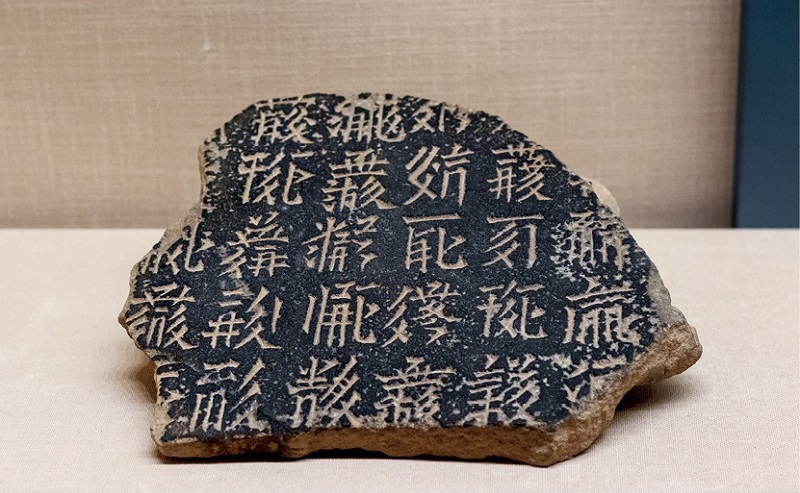
A fragmented stele inscribed with the Xixia script on display at the Ningxia Museum.
Stone Male Pedestal
The Strongman-shaped Stone Pedestal with Inscriptions is another national treasure excavated from the Xixia Imperial Tombs. This stone piece measures 60.4 centimeters in length, 59.8 centimeters in width, and 64 centimeters in height, forming an almost cubic shape.
In ancient China, animal patterns were more commonly seen on pedestals while human forms depicted as such were rare. This work depicts a stern-looking strongman carved in a relief kneeling on the ground, hands pressed down on his knees, brows tightly furrowed, and teeth clenched. The creation vividly shows the immense burden borne by the figure through his expressions and gestures.
Fourteen such "human-like pedestals" have been excavated from the site, but only this one has been designated a national treasure because of its inscriptions. On the upper left of the pedestal are three incised lines of Xixia script totaling fifteen characters, detailing the process of its production. On the back is an inscription in Chinese recording the name of an artisan, "Masonry Craftsman Gao Shichang," the only personal name known among the many builders of the tombs. This artifact provides tangible evidence of the use of the Tangut script and attests to collaboration between Han and Xixia artisans.
A Celestial Bird
The green-glazed Kalavinka (Buddhist celestial bird) is an elegant architectural ornament also excavated from the Xixia Imperial Tombs. It was the first ever discovery of Kalavinka as an architectural component unearthed in China. "Kalavinka" is a transliteration from Sanskrit; in Chinese it is known as the "Miaoyin Bird (Bird of Wondrous Sound)." In Buddhist belief, it is a bird with a human face from snowy mountains whose melodious voice is said to purify the listener's spirit.
Xixia was a Buddhist society, so Kalavinka figures in Xixia retain their original Buddhist meaning and bear the Tangut aesthetic elements. This green-glazed Kalavinka is portrayed with a serene expression and distinct features of the Tangut. The object was produced through a complex process in which different parts were molded separately and then joined together.
At the Xixia Imperial Tombs, such figures were primarily placed on roof ridges as primary rooftop ornaments. In the Northern Song's book State Building Standards, the Miaoyin Bird is described as a common ornament on high-ranking buildings, often used in combination with bronze bells to symbolize the "wondrous sounds." Since the rise of Taoism in the Ming Dynasty (1368-1644), the Taoist motif of "immortals riding phoenixes" gradually replaced the singing bird. Today, reassembled with surviving fragments, these bird figurines have restored their former grace.
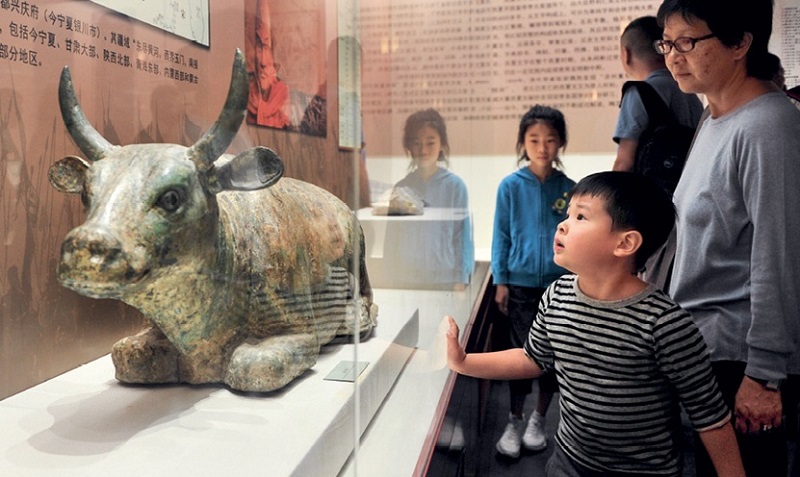
Visitors marvelling at the Ningxia Museum's signature object, the Gilded Bronze Ox.
Sogdian Whirl Dancers
The Stone Gate Carved with Sogdian Whirl Dancers is another national treasure of the Ningxia Museum. It was unearthed from a Five Dyansties (907-960) tomb in Ningxia.
The tomb gate consists of a pair of stone doors. When excavated, the doors were tightly closed and secured with an iron lock. Each door displays a male dancer performing the Sogdian Whirl Dance in a relief. Originating in today's Central Asia, the dance spread to China via the ancient Silk Road and became extremely popular during the Tang Dynasty (618-907).
The dancers portrayed on the gate display typical "Sogdian" features: their hair is tied with a band; they wear tight, narrow-sleeved, round-collared tops, close-fitted skirts, and knee-high leather boots, dancing atop finely woven round carpets. Cloud patterns surround them, making it appear that the dancers are leaping and spinning amid drifting clouds.
Mu Shaojuan, associate researcher at the Ningxia Museum, noted that this gate not only testifies of the dance that was merely mentioned in historical records, but also reflects the migration and settlement of Sogdian people along the Silk Road.
Public Education
The Ningxia Museum has been working to disseminate traditional culture through a wide range of public education programs. For young people, the museum offers study tour programs, including a junior docent training camp, role playing experiences, and hands-on activities. These initiatives help foster an interest in history among young participants.
The museum also promotes cultural traditions through intangible cultural heritage showcases, skills demonstrations, and workshops such as paper cutting, clay sculpture, movable-type printing, and other traditional crafts. In addition, the museum integrates education on cultural heritage protection regulations into its programs using quizzes, displays, and lectures to enhance public awareness of China's heritage preservation system.