


Zhu Bingren: Copper Artist Extraordinaire
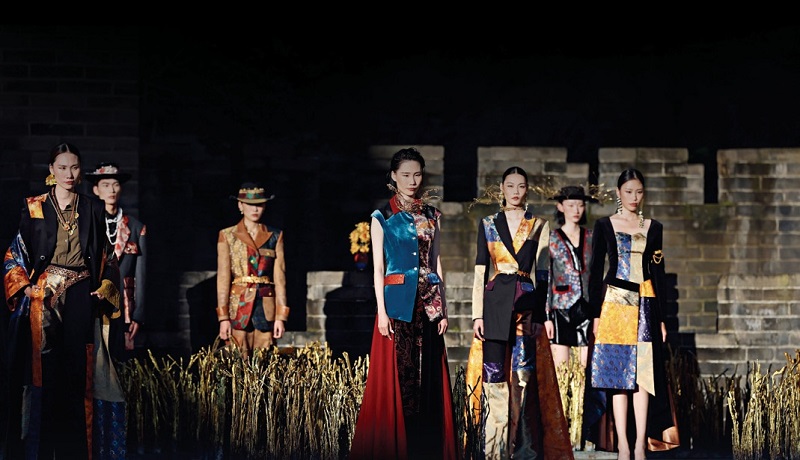
During the SS2026 Beijing Fashion Week, more than 50 outfits – created in dialogue with artificial intelligence by Zhu Bingren – tell a narrative of craftsmanship and its future through three series: Denim, Suit, and Brocade.
The copper art should not be confined to display cases, believes artist Zhu Bingren. From living rooms to fashion runways, and from the Great Wall in Beijing to the Louvre in Paris, the Chinese master craftsman brings his metal creations to life in diverse settings. In an interview with China Today, the 82-year-old revealed the secret to both his and his art's enduring vitality.
Zhu has contributed so profoundly to his country's cultural heritage that he himself deserves to be cast in bronze – and not merely because bronze is his chosen medium. Born in 1944 in the historic city of Shaoxing, east China's Zhejiang Province, Zhu carries his years lightly; his energetic presence and lively, intelligent eyes suggest a man decades younger. It is this very vitality that allows him to make copper "flow," both as a material and as a cultural force, and that has established him as the representative master of China's nationally protected copper sculpture technique, an intangible cultural heritage since 2008.
Far from a relic of the past, Zhu approaches his craft with the dynamism of a young entrepreneur and the curiosity of a researcher. He continually revitalizes this heritage by reinterpreting it, presenting it in new contexts, and exploring its modern possibilities. Now, the octogenarian is embarking on one of his boldest transformations: from sculptor to fashion designer.
All Starting in the Workshop
Zhu's path was shaped early. Hailing from a family engaged in copper craftsmanship for generations, he represents the fourth generation in this lineage. The rhythm of hammers striking metal, the hiss of the forge, the dense scent of molten copper – these were the sensory anchors of his childhood. For Zhu, copper was never just a material; it was a language, a heritage, and a calling.
His masterful craftsmanship can be found across China, often on a scale so grand that it must be viewed from a distance to be fully grasped: the copper roofs and ornaments of Hangzhou's Leifeng Pagoda, the majestic copper hall of the Lingyin Temple, the golden summit of Mount Emei, and the magnificent Lingshan Brahma Palace in Wuxi. Each bears his creative imprint.His works reside in the country's most distinguished collections, from the National Museum of China and the Great Hall of the People to the Forbidden City. In recognition of his achievements, he has been hornored as a "Chinese Master of Arts and Crafts" and awarded the National May 1 Labor Medal by the country.
But Zhu was never content merely to simply replicate tradition. Early on, he understood that "a craft does not die when it is transformed; it dies when it ceases to evolve." Guided by this conviction, he became a pioneering innovator, securing more than 60 national patents. These include techniques such as multi-layered reliefs, specialized etching methods, and "Zijin" engraving, which imparts copper with amazing novel colors and textures.
Zhu's decisive artistic breakthrough came with "Rongtong," the art of "molten copper." Here, he truly set copper free: rather than pouring it into prepared molds, he allowed the glowing, liquid bronze to flow unrestrained, thus creating a completely new aesthetic that bridges abstraction and figuration, chance and control. The resulting sculptures resemble solidified lava, liquid light, or the contours of an unknown world. This "Rongtong" aesthetic would lay the foundation for his next, unexpected venture.
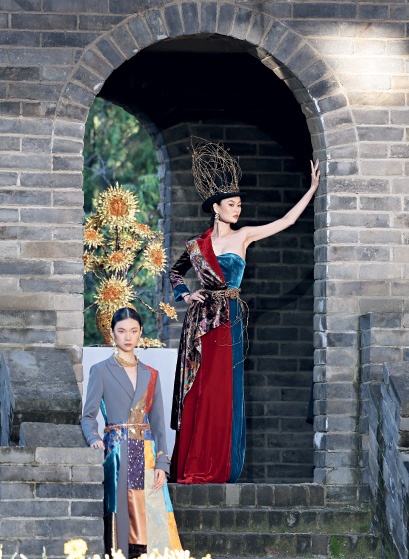
At the closing event of the Beijing Fashion Week in 2025, Zhu Bingren presents his collection "Craftsman Fusion Wear" at the Simatai section of the Great Wall. The guiding leitmotif: Rong – Melting and Merging.
His Textile Era Begins
In 2024, Zhu embarked on a new creative journey, entering the world of fashion. Under the label "Yunmo Rongzhuang" (Cloud-Ink Fusion Attire), he began transferring the textures of molten copper and the fluid forms of Chinese ink wash painting onto textiles. After making appearances at Milan Fashion Week, his collection was presented in a major showcase at the Louvre in Paris, held in celebration of the 60th anniversary of China-France diplomatic ties.
The provisional high point of this journey was a spectacular show in September 2025 on the Simatai section of the Great Wall. As the finale of the SS2026 Beijing Fashion Week, Zhu presented his collection Craftsman Fusion Wear. Over 50 outfits, created in a dialogue with artificial intelligence, unfolded a narrative of craftsmanship and its future through three series: Denim, Suit, and Brocade. The unifying theme was Rong – Melting and Merging.
When asked about his experience with this unconventional collaboration with AI, Zhu reflected: "I think the interaction with artificial intelligence is very good. It's about completely integrating modern technology with our traditional Chinese culture."
Yet, he stressed the irreplaceable role of the human artist in this process, "I asked the machine what a craftsman wears in his dreams. It showed me images, but I decided which to keep."
Opening Up to Preserve
With his landmark show on the Great Wall, the most symbolic of all Chinese cultural sites, Zhu spectacularly showcased his art, demonstrating that traditional copperwork can be living, breathing, and even wearable. By translating the ancient "Rong" aesthetic into fashion, he opened up a heritage art form to a completely new, young, and international audience. In doing so, he rendered a millennia-old craft into a universal language understood by all: the language of beauty and contemporary expression.
His motivation is deeply rooted in his sense of identity, "As a bearer of a national intangible cultural heritage, it is my innate duty and responsibility, and naturally, I must fulfill it well," Zhu explained.
Yet for him, this mission is not about museum-like preservation, but about dynamic evolution. Together with his son, he founded the brand Zhu Bingren Tong in 2008, integrating copper art into furniture, everyday objects, and architecture. In this way, he brings the heritage out of temples and palaces into people's living rooms.
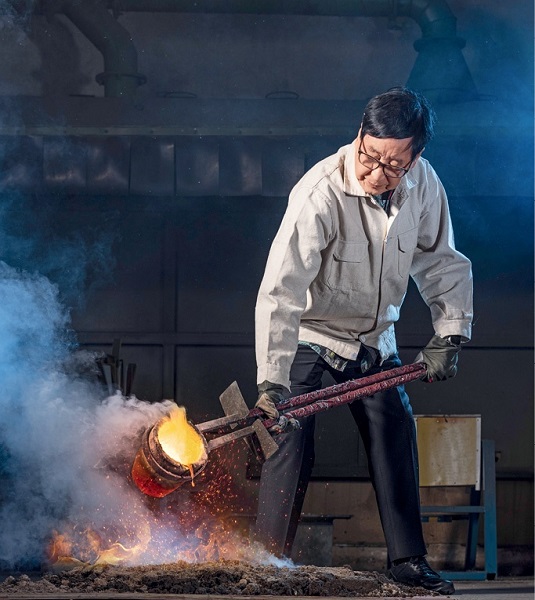
Zhu Bingren is casting boiling molten copper.
Wisdom Fuels Creative Rebirth
Zhu, who speaks with a laugh of a "second beginning" at his ripe old age, radiates a rare mix of serenity and unbridled creative energy, a harmony of the wisdom of age and the vitality of youth. His artistic philosophy is marked by deep confidence in the creative process, one that leaves room for the unexpected.
"There are many coincidences, many surprises along the way. If we harness them rightly, they become part of the journey. Within these unplanned moments, we often discover what we are truly seeking for. What we do not need, we let go, allowing it to nourish our spirit. What is good, we keep in memory," he said.
This attitude perhaps explains why a man of his age is still so eager to venture into new frontiers. He is not a patriarch guarding his realm, but an explorer for whom the heritage of the past is the fuel for the future.
Zhu Bingren is more than a master craftsman. He is a storyteller whose medium transforms from solid to liquid, from bronze to fabric. He is a bridge-builder between generations, between tradition and high-tech, breathing the warmth of ingenious craftsmanship into the sterile algorithms of AI. And, along with his creative flair, he also has a keen understanding of cultural outreach, "It is essential to bring Chinese culture to the world."