


A Home for the Ages
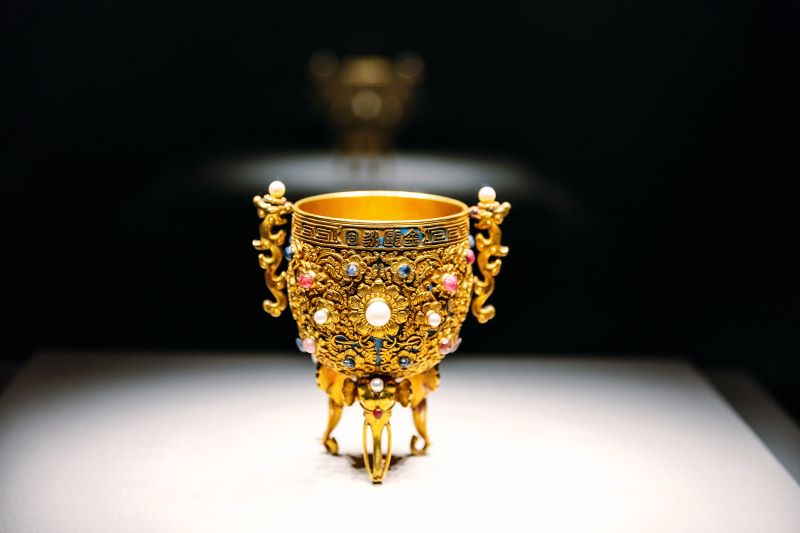
The Golden Chalice of Eternal Stability from the Qing Dynasty. (Photo by Duan Wei/China Pictorial)
To celebrate its centenary, the Palace Museum launched an exhibition titled "A Century of Stewardship: From the Forbidden City to the Palace Museum" on September 29, 2025. This exhibition consists of three sections: "A Lineage of Civilization," "A Century of Endeavor," and "Myriad Visions of Splendor." It traces the Palace Museum's journey over the past hundred years with a display of 200 artifacts.
The first section ,"A Lineage of Civilization," is located in the West Wing Gallery of the Meridian Gate in the Palace Museum. It systematically presents the continuity, preservation, and utilization of imperial collections. It also vividly portrays key scenes in the museum's early history including its founding, the adoption of the comprehensive conservation plan, the wartime transfer of cultural relics to the south, and the surveying and mapping of the Beijing Central Axis. This section showcases the Palace Museum's early efforts to safeguard and research the nation's cultural heritage.
In the West Wing Gallery, visitors are greeted by a pair of cloisonné elephants with vases symbolizing peace and prosperity. This pair of decorations was among the earliest cultural relics in the Palace Museum with accession numbers. Also displayed in the gallery are the full set of "Twenty-five Cardinal Seals" of the Qianlong period in the Qing Dynasty (1644-1911), a witness to the legal and administrative systems of the Qing court. The precious joint display of the 25 imperial seals allows visitors to have close contact with symbols of supreme imperial authority in ancient China, exemplifying the former imperial palace's transition into a public museum.
Over the past century, the Palace Museum has been continually refining its operations with richer collections, more sophisticated restoration technology, and more advanced conservation principles.
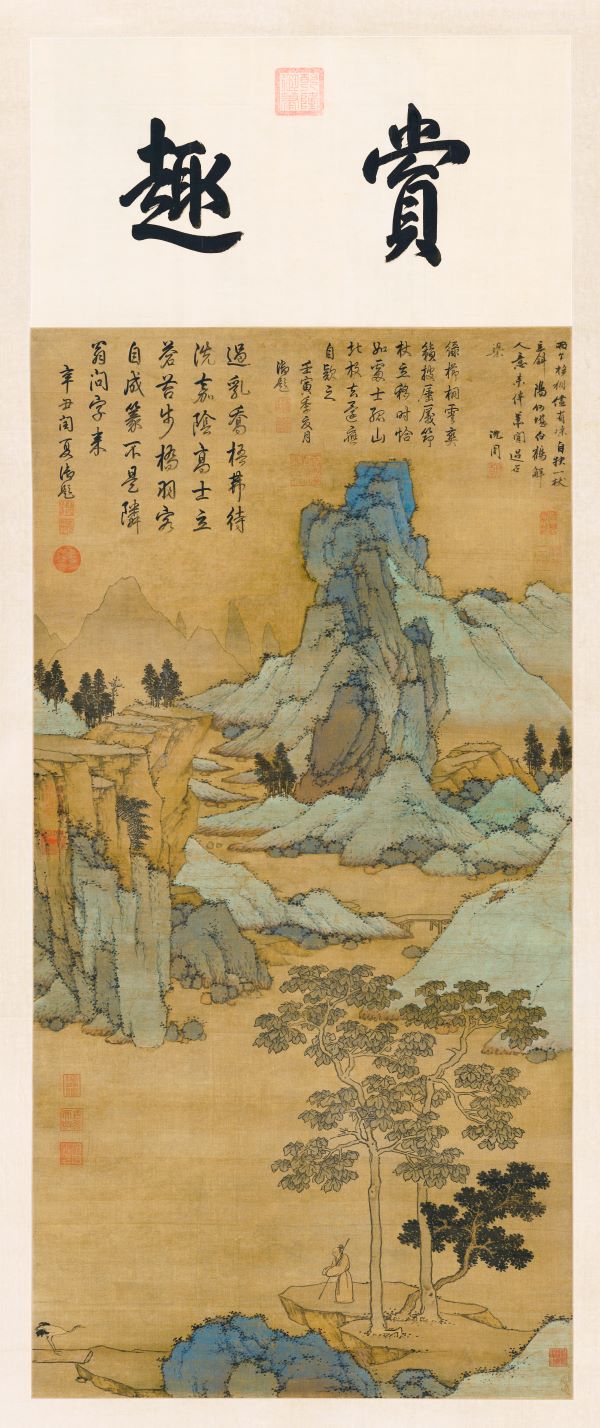
Crane and Old Man under the Shade of Phoenix Trees, a painting by Shen Zhou from the Ming Dynasty (1368-1644)
The section "A Century of Endeavor" is located in the Main Hall Gallery of the Meridian Gate. This section outlines the three main methods by which the Palace Museum's collections are systematically built: repurchase, transfer, and donation. It fully showcases technologies used in artifact conservation and restoration. This section also highlights innovative practices to preserve ancient buildings like the restoration of the Hall of Supreme Harmony as well as UNESCO World Heritage status applications for the Palace Museum and the Beijing Central Axis.
A wealth of imperial artifacts had been lost by the end of the Qing Dynasty. After the founding of the People's Republic of China in 1949, many national treasures were repatriated back to the Palace Museum. One of the most notable returnees was the ancient painting Along the River During the Qingming Festival by Zhang Zeduan (1085-1145) from the Northern Song Dynasty (960-1127). Now, it has been rejuvenated with its original beauty and vitality thanks to the extraordinary skills of the patient restorers at the Palace Museum.
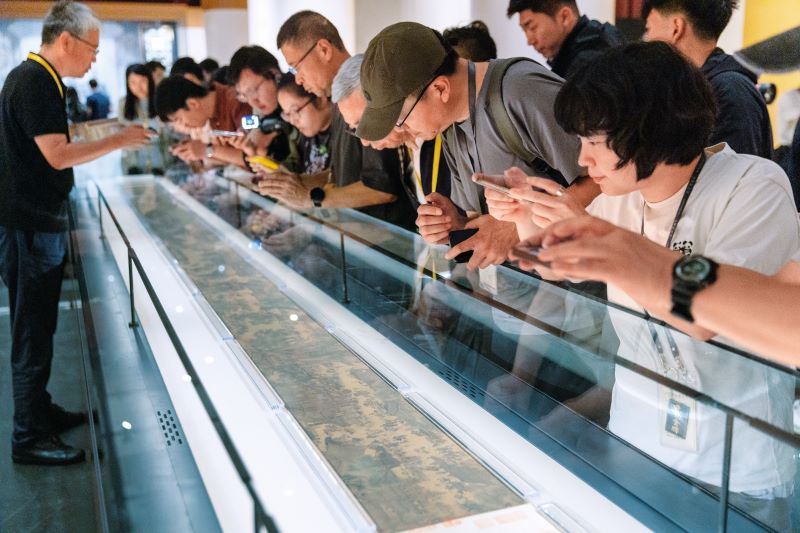
Visitors appreciate the world-famous ancient painting Along the River During the Qingming Festival at the exhibition. (Photo by Duan Wei/China Pictorial)
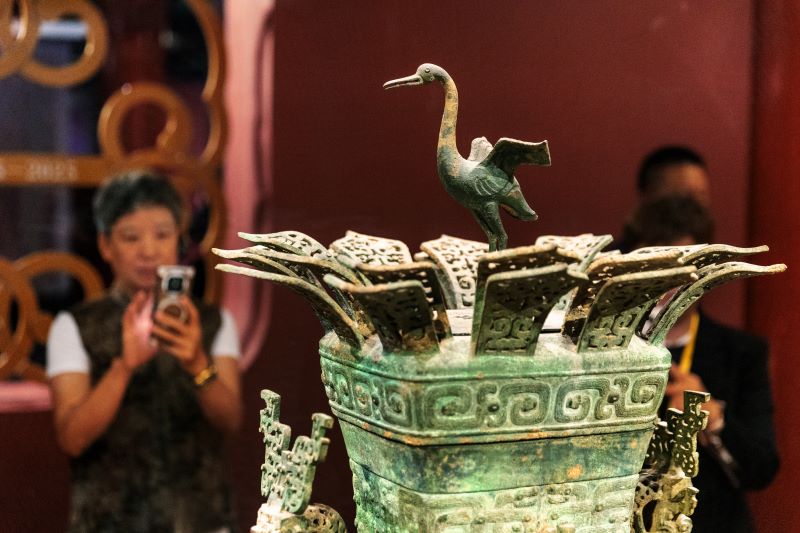
A bronze lotus-crane square pot from the Spring and Autumn Period. (Photo by Duan Wei/China Pictorial)
The final section, "Myriad Visions of Splendor," is situated in the East Wing Gallery of the Meridian Gate. It comprehensively illustrates how the Palace Museum has climbed far past a "treasure trove" to become an educational hub and exchange platform.
Notable exhibits in this section include a bronze lotus-crane square pot from the Spring and Autumn Period (770-476 B.C.), the Golden Chalice of Eternal Stability used by emperors at the ceremony for handwriting on Chinese New Year during the Qing Dynasty, as a way to pray for a promising future for the nation, and a jade cong (tube) from the Liangzhu Culture which testifies to ancient knowledge of the universe and earth.
The final item on display is a jade chime with gild cloud and dragon patterns. The chime was an ancient ritual musical instrument, generating sound that symbolizes the dissemination of Chinese culture and harmony of the world. It also represents the Palace Museum's new beginning as it enters the next century.